
Alleviating Motion Sickness in Vehicle Passengers
Overview
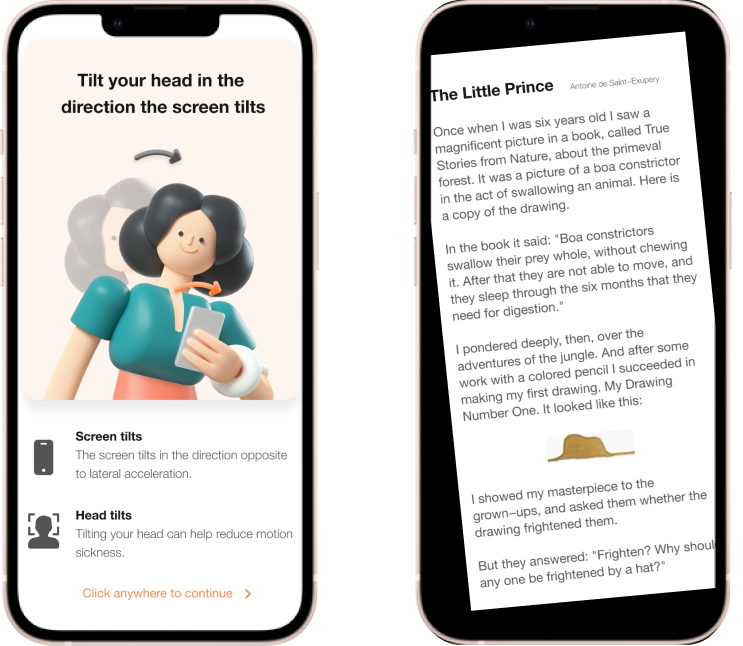
Motion sickness in vehicles is elevated when passengers perform visual tasks like reading, messaging, and navigating. While the increase in the number of autonomous vehicles liberates people from driving, today’s busy lifestyles create a need for passengers to perform these tasks during their commute. QP is a tilting software interface that helps reduce passengers’ motion sickness while they perform tasks on their digital devices. The concept of tilting the user’s head in sync with the car’s lateral acceleration has proven to be effective in reducing motion sickness.
Publication
IEEE ‘22 - An Adaptive Tilting Interface to Alleviate Motion Sickness for Passengers in Vehicles
PETRA ‘22 - An Adaptive Tilting Interface to Alleviate Motion Sickness for Passengers in Vehicles
2022 Alaska Airline Environment Competition Finalist
2022 UW Dempsy Startup Competition Finalist
My Role
Lead UX Design
UX Research
User Interview & Testing
Create Scenario
Mobile app UI Design
Interface Prototyping
Team
2 Software Developer
1 Researcher

Problem
One in every three people experiences high levels of motion sickness.
Motion sickness is further elevated when people perform tasks like reading, messaging, and navigating. With the increased need to be productive in today’s world, and with the increase in the number of autonomous cars, passengers find the need to perform these tasks.
Solution
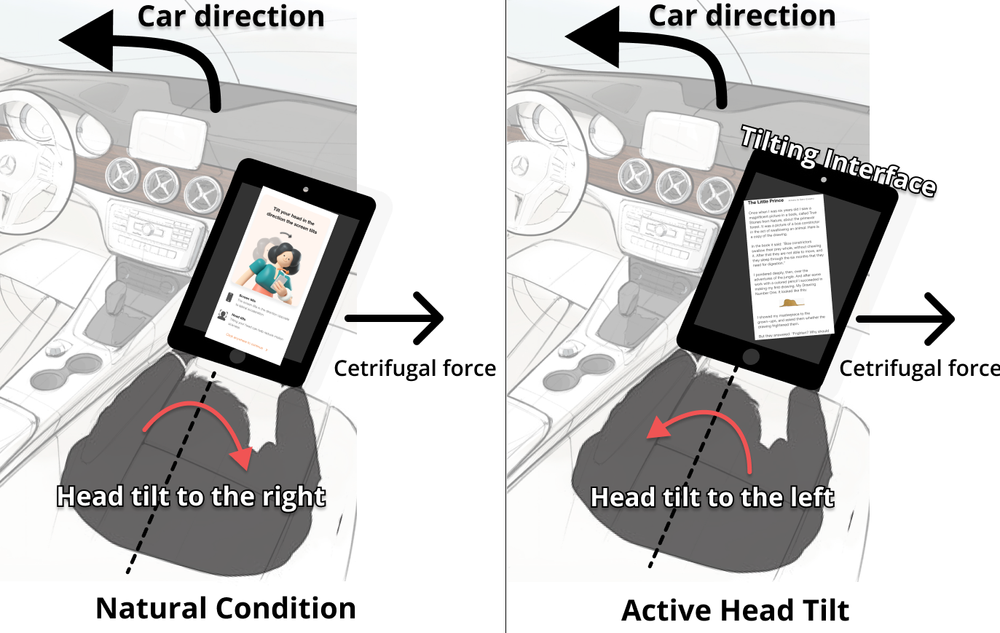
An interface that assists users to tilt their head in response to the lateral acceleration of the car.
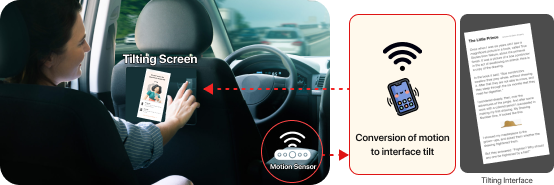
1. The interface responds to the lateral acceleration of the vehicle by receiving real time lateral acceleration data from an accelerometer placed in the vehicle.
2. An interface that assists users to tilt their head in response to the lateral acceleration of the car.
3. The user tilts their head in the same direction of the interface tilt (towards the center of the curve) in response to the interface tilt, to better read the interface.

Scenario
I created the user scenario to deliver our service to audiences.
Design Considerations

Provide gradual tilt of interface, to assist users to tilt their head.
Filter out the jerky motions of the vehicle to avoid rapid tilts in the interface.
Software & Hardware
It is known that drivers don’t feel motion sickness but passengers do.
Active head-tilt against the lateral acceleration of the vehicle, just like the driver does while driving, significantly reduces motion sickness in passengers too.[3]
User Testing
We tested with 5 participants (4 Male and 1 Female), who claimed to use digital devices like tablets or mobile phones while commuting.
The study was conducted in an outdoor parking lot under controlled conditions. A single driver performed all drives, having practiced a set driving path, acceleration, and vehicle speed beforehand to guarantee repeatability.
During the experiment, participants read a passage from the tilting QP interface for 10 minutes and were interviewed to share their experience with the prototype for 5 minutes.
Test Results
Design Iteration
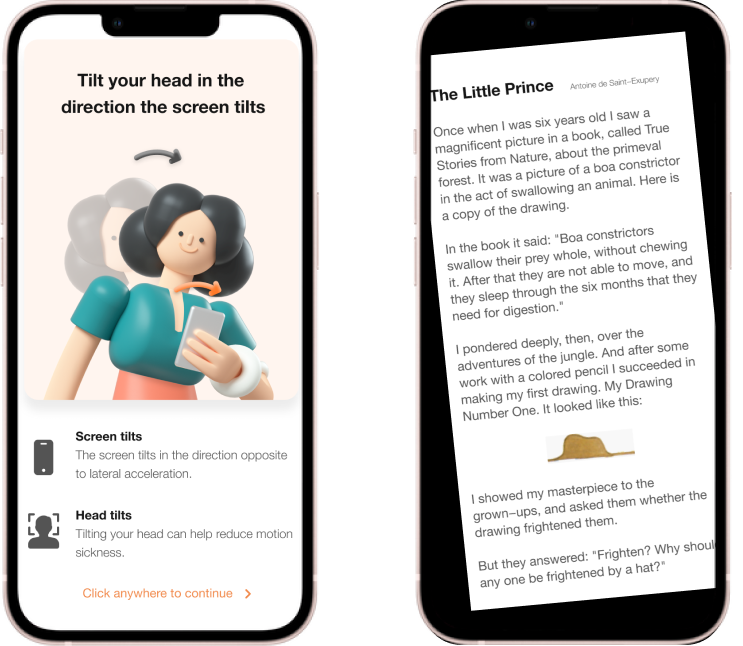
Adding a tutorial to introduce the user to the concept of the user and guiding the user to tilt their head.
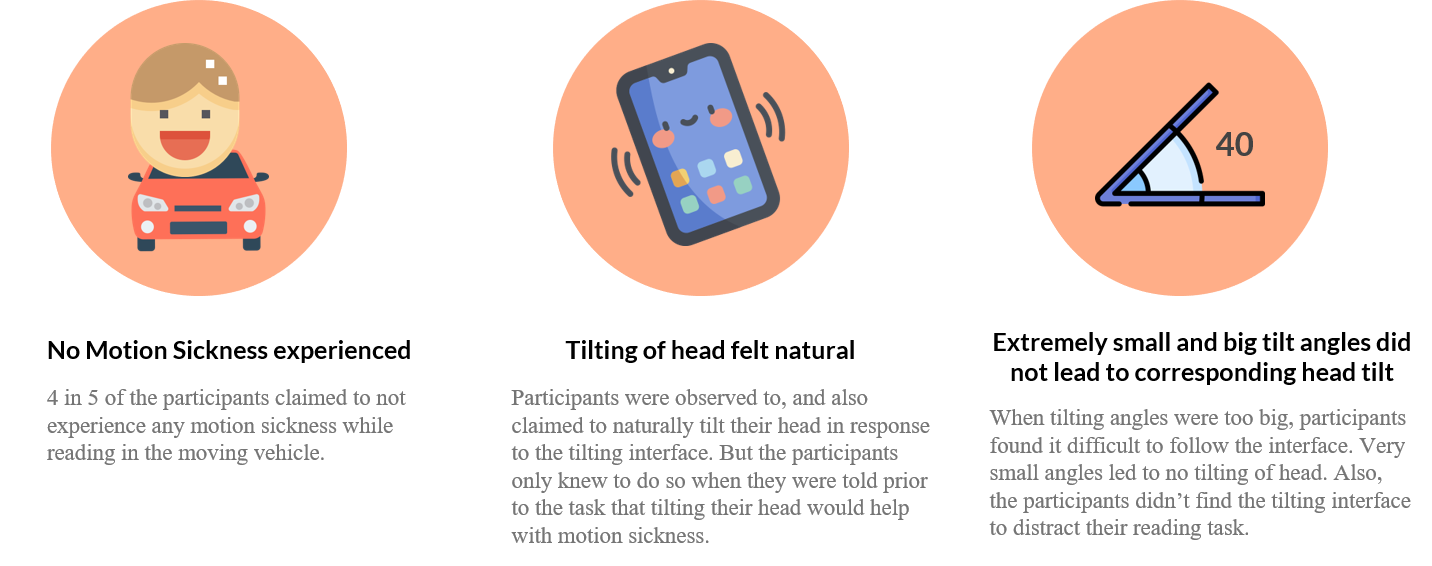
Fine-tuning of the acceleration-to-tilt conversion factor could probe towards finding the least amount of interface tilt that still effectively induces passenger head-tilt.